04 · Safety-critical UX
Metro Driver's Guidebook
Metro Driver's Guidebook · Design Manager · Opposite
- 05 Operational stages
- 16 Rail lines supported
- Tablet Format
04 · Safety-critical UX
Metro Driver's Guidebook · Design Manager · Opposite
Case study
I designed the information architecture and tablet experience that transformed complex train-driver procedures into a navigable, safety-critical operational guide organized around the stages and steps of a driver's work. The broader training system also included route media, 360° and 4K recordings, and visual hazard cues across Melbourne's rail network.
Stages
5
operational sequence
Rail lines
16
360° + 4K recorded
Format
Tablet
field-oriented
01 · Problem
0102/08
Train-driver procedures contain large amounts of safety-critical information. A conventional linear manual makes it difficult to understand where a driver is in the overall operating sequence and to move quickly to the instruction relevant to the current task.
The design challenge was to improve navigation and comprehension while preserving the accuracy, sequence and authority of the original procedures.
02 · Architecture
0203/08
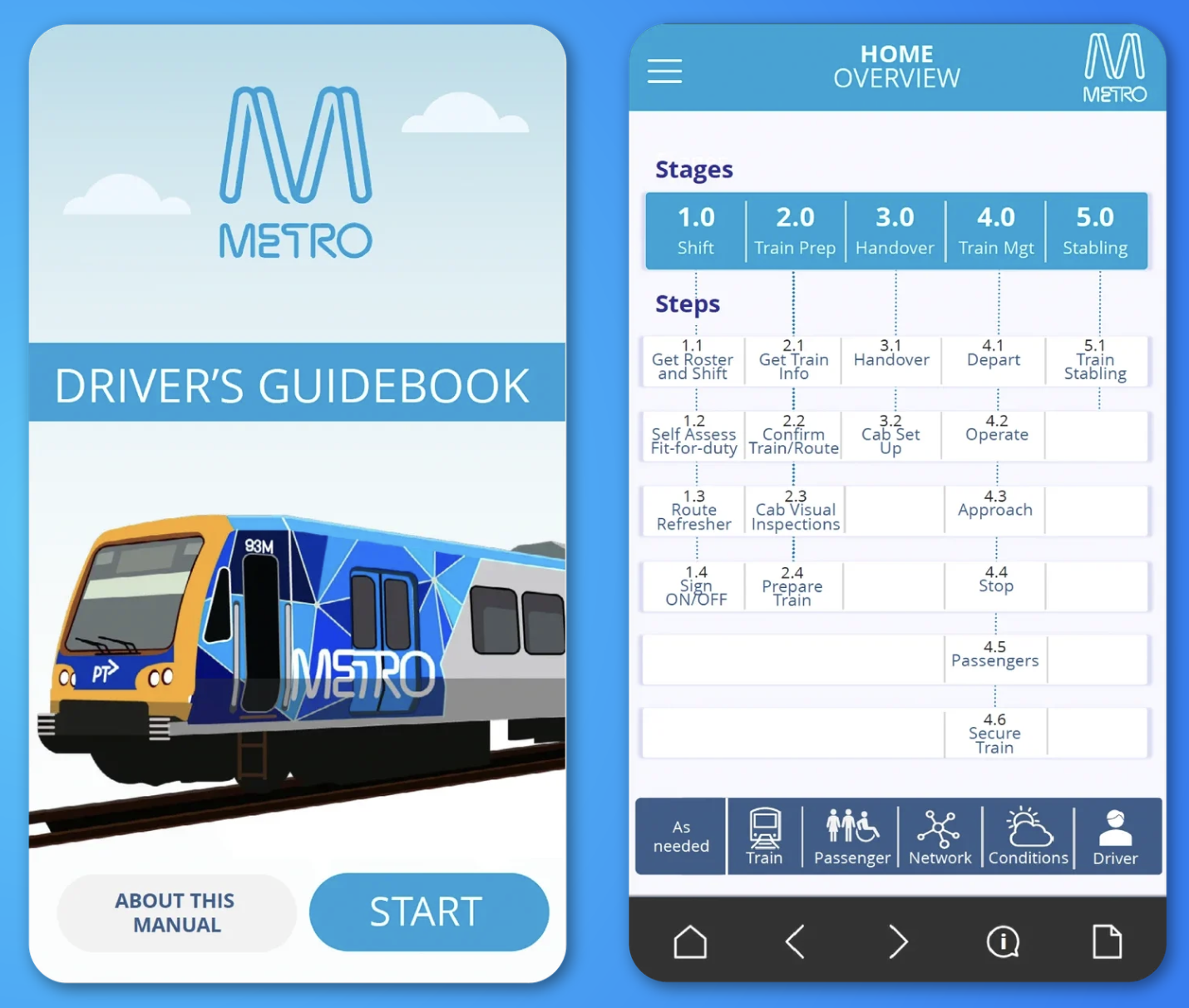
I helped organize the experience around five major stages: Shift, Train Preparation, Handover, Train Management and Stabling. Each stage was divided into numbered steps so drivers could understand both the full operating sequence and their current position within it.
Supporting categories — such as train, passenger, network, conditions, driver and as-needed information — provided another way to reach relevant guidance.
03 · Interface
0304/08
The interface was designed for a tablet format with large touch targets, clear stage labels, strong color coding and persistent navigation. The home overview gave drivers a visual map before they entered detailed content.
Stakeholder review and testing informed the interaction and visual refinements. In a safety-critical context, clarity, consistency and predictability mattered more than decorative novelty.
Interface · Driver's guidebook
Desktop
Five operational stages, numbered steps and contextual categories, designed for a tablet inside the cab.
04 · Media
0405/08
The broader project included 360° and 4K route recordings across 16 Melbourne rail lines, covering outbound and inbound journeys. Animation overlays helped drivers recognize hazards and important environmental cues along each route.
Procedures explained what to do; route media helped drivers recognize where attention was required in the real environment.
05 · Validation
0506/08
Approved overview screens, navigation patterns and taxonomy were reviewed with operational stakeholders. Feedback shaped iteration on hierarchy, terminology and interaction, keeping the design close to how drivers actually reach for information under pressure.
06 · Value
0607/08
The redesigned guidebook made procedures easier to enter, easier to place within the operating sequence and easier to reinforce with route media. Confidential operational content is not published — the case shows the design system and reasoning, not the procedures themselves.
07 · Reflection
0708/08
Metro taught me that simplification is not the removal of detail. In safety-critical products, it is the disciplined organization of detail so people can find, understand and act on the right information at the right time.